I early January, 2017, I will be traveling to Costa Rica! This will be part of my Public Health clinical experience, as I am a nursing student. The main purpose of this trip is to implement public health interventions and projects to populations in need. Prior to my trip, I have done quite a bit of research on the country and compiled a preliminary Needs Assessment for the city of La Carpio, Costa Rica. My Needs Assessment consists of a Windshield Assessment and a SWOT (Strengths, Weaknesses, Opportunities & Threats) Analysis of La Carpio. In my Windshield Assessment I identify many aspects of La Carpio, which helped me to better understand the area.
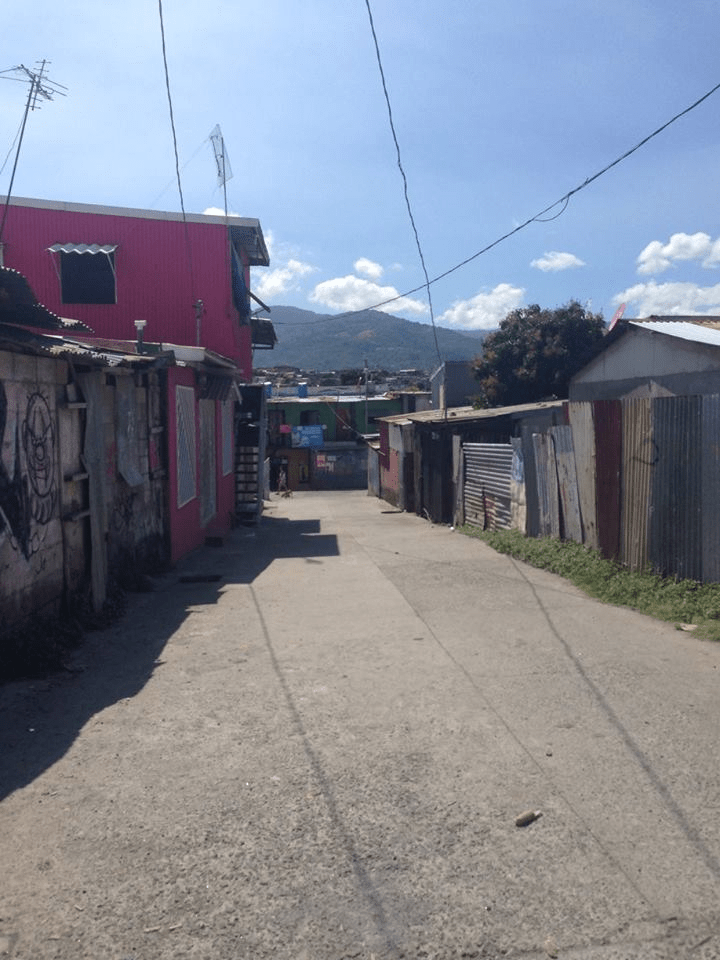
*The photo above shows the streets of La Carpio. Poverty and instability is evident.
My Windshield Assessment is as follows:
La Carpio, Costa Rica – located in San José, Costa Rica. San José is a province of Costa Rica, as well as the capital of the country and Costa Rica’s largest city (“San José, Costa Rica,” 2016).
- Housing- age, architecture, materials, similarity, general condition.
- Old materials that appear to be recycled from other uses are used to build houses in La Carpio; such as tin panels and wood. Single level houses. Housing is close together, area seems to be densely populated. Homes do not appear to be very weather resistant or sturdy for extreme weather conditions. No real security for homes. Some electricity. Use outdoor plumbing/ outhouses.
- Boundaries- where does the community begin and end
- The northern border of Costa Rica meets Nicaragua, and the southern edge meets Panama (“Costa Rica,” n.d.). The northern boundary of La Carpio is defined by Río Virilla, while the southern and eastern borders runs along Río Toíres (“La Carpio,” n.d.).
- Commons- neighborhood hangouts, hours open, restaurants, parks, drugstores, etc.
- Kids hangout on the streets playing games with local children. Appears to be a paved park/sports area for children to play. There are two known drugstores with pharmacies in La Carpio.
- Transportation, major highways, road conditions, public transportation, gas stations
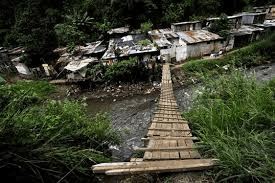
- Some paved road, others are dirt. Some cars and busses for transportation. Most people get around on foot to local destinations. Foot bridge for residents to cross the river.
- Service centers- social service agencies, rec centers, schools, and activities at the schools, health care providers, spiritualists, palmists, dentist, doctors
- Appears to be one church and some schools, but no high school or college/universities. Costa Rican Humanitarian Foundation volunteers at local schools in La Carpio. Library was pictured to be in La Carpio. A few health clinics, but not having the same standards as our hospitals in the U.S. The poor residents try to find any jobs they can get, including garbage pickup, house cleaning and outdoor maintenance for richer homes. Police presence for protection. Police have authority to remove children from unsafe homes; similar to our CPS system.
- Some small shops. Vendor carts sell groceries.
- Street People- who do you see outside, how many, animals, pets, etc.
- People living in La Carpio include “thousands of refugees from the Nicaraguan civil war of the 1980’s and 90’s have settled. They are mostly undocumented immigrants, and they have been mostly ignored by the governments of San José and Costa Rica” (Miller, 2015). Many children play in the streets as this is their only form of entertainment. Stray dogs running around the streets.
- Housing falling apart, graffiti, garbage, not well kept.
- “White (including mestizo) 94%, black 3%, Amerindian 1%, Chinese 1%, other 1%” (“Ethnicity and Race by Countries,” 2000).
- Nicaraguan immigrants and Central American.
- Religion and religious houses
- Christian. Multiple churches.
- Health and morbidity- do you see signs of chronic diseases or conditions, accidents, alcoholism, drug addiction, mental illness etc., where are the hospitals and clinic
- No hospital in La Carpio, but Hospital Mexico is to the east. Hospital Mexico is a 13-minute drive, or about an hour walk from La Carpio. Disease is easily transmitted because of the lack of education, close living conditions, and lack of sanitation. The Costa Rican Humanitarian Foundation (CRHF) has a community clinic in La Carpio. This clinic includes many health services and therapies (“La Carpio,” 2016). Yellow fever is prevalent in La Carpio.
- Politics- do you see any campaign posters, a headquarters, and predominant party affiliation?
- Democratic government. Costa Rica does have a president who is elected every 4 years, as well as two Vice Presidents at a time.
- Media, do you see satellite dishes, antennae, types of media in stores. What TV and radio reception is available? Cell phone availability?
- La Carpio is a poor community. They do not have cell phones or advanced technology. They do have some electricity, but it is not always reliable. Many families cannot afford electricity.
Costa Rica. Retrieved October 20, 2016, from Google Maps, https://www.google.com/maps/place/Costa+Rica/@9.622939,- 86.4987101,7z/data=!3m1!4b1!4m5!3m4!1s0x8f92e56221acc925:0x6254f72535819a2b! 8m2!3d9.748917!4d-83.753428
Ethnicity and Race by Countries. (2000). Retrieved October 20, 2016, from InfoPlease, http://www.infoplease.com/ipa/A0855617.html
La Carpio. (2016). Retrieved October 20, 2016, from Costa Rican Humanitarian Foundation, http://www.crhf.org/
La Carpio. Retrieved October 20, 2016, from Google Maps, https://www.google.com/maps/place/La+Carpio,+San+Jos%C3%A9+Province,+San+Jos %C3%A9,+Costa+Rica/@9.9632005,-84.1550686,17z/data=!4m5!3m4!1s0x8fa0fb98a09e5e37:0xb88f5c59c7edc3ef!8m2!3d9. 9611015!4d-84.150109
Miller, M. (2015, January 30). La Carpio may be Costa Rica’s worst ghetto – the real San José. Retrieved October 20, 2016, from The Real San José, http://www.therealsanjose.com/la-carpio-may-costa-ricas-worst-ghetto/
San José, Costa Rica (2016). . In Wikipedia. Retrieved from https://en.wikipedia.org/wiki/San_Jos%C3%A9,_Costa_Rica
 Costa Rica 2017